 ISO 9001, ISO 14001, ISO 45001, and IECQ QC080000
 Over 15 Years of Expertise
 FREE samples provided to ensure product satisfaction
 Rapid Turnaround: Mass Production Complete in 15 - 20 Days
Ever wonder how all those components inside your smartphone manage to talk to each other when there’s barely any space between them? That’s where fine pitch pogo pins come in. These tiny spring-loaded connectors create reliable electrical connections in spaces as small as 0.15 mm apart, about the width of a human hair.
At Promax Pogo Pin, we’ve spent years perfecting these microscopic marvels. Our ultra-precise spring-loaded solutions deliver consistent performance in places where space is tight. Whether it’s semiconductor testing equipment, those life-saving miniaturized medical devices, or the next generation of electronics where every fraction of a millimeter counts, our interconnect products make the seemingly impossible connections happen.
What are Fine Pitch Pogo Pins?
Fine pitch connectors are tiny spring-loaded contacts spaced 1.27 mm apart or less. That’s thinner than a credit card! These aren’t your average electrical connections.
Each spring pin connectors pack a precision-machined plunger, barrel component, and a miniature spring mechanism that maintains perfect contact even when subjected to vibration, movement, or temperature changes that would make regular connectors fail completely.
The “fine pitch” name comes from how close these pins can be placed next to each other. This ultra-tight spacing is what allows engineers to create those impossibly dense PCB layouts that make your smartphone thinner than a pencil or cram more computing power into a wearable device than desktop computers had a decade ago. When every fraction of a millimeter counts, these specialized connectors become absolute game-changers.
Key Applications
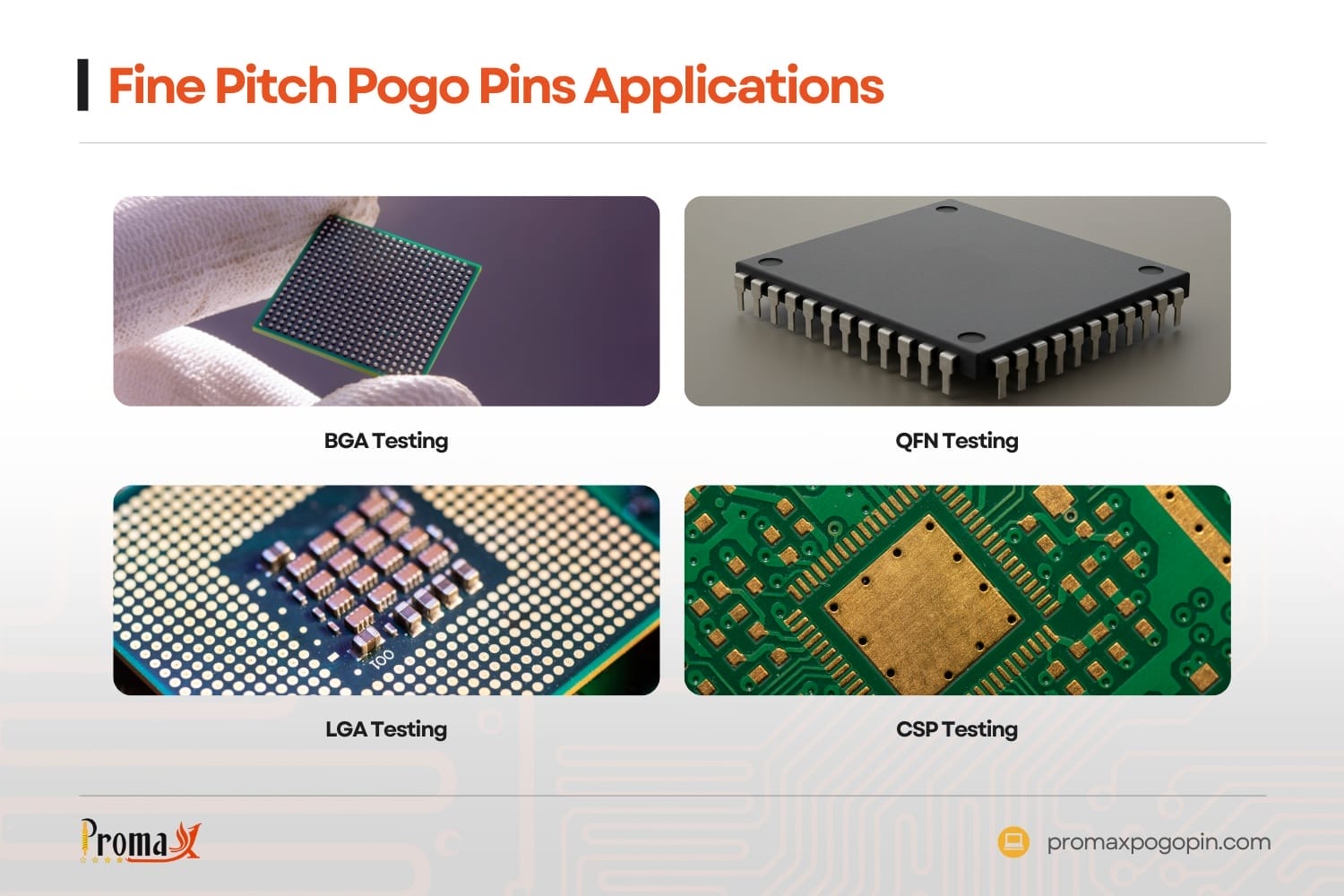
- BGA Testing: Ball Grid Array packages with 0.4 mm to 1.0 mm grid spacing
- QFN Testing: Quad Flat No-Lead packages requiring 0.4 mm to 0.65 mm spacing
- LGA Testing: Land Grid Array packages with 0.5 mm to 1.27 mm spacing
- CSP Testing: Chip Scale Packages demanding 0.15 mm to 0.30 mm spacing
Traditional connectors fail in high-density applications because their physical dimensions prevent proper spacing in miniaturized circuits. Pogo pins overcome these limitations through specialized manufacturing processes that produce diameter specifications as small as 0.2 mm for ultra-fine pitch contacting.
How do Fine Pitch Pogo Pins Achieve Reliable Electrical Contact?
Spring contact probes maintain electrical reliability through precision-engineered spring mechanisms that apply controlled normal force against target surfaces. The helical spring inside each probe generates approximately 1 newton of force, creating sufficient friction to prevent disconnection during vibration while minimizing wear on contact surfaces. This force application ensures consistent electrical pathways even in dynamic operating environments.
Contact Mechanism Features
- Plunger Tilt Design: Prevents momentary disconnections during vibration
- Spring Force Control: 6–30 grams depending on application requirements
- Gold Plated Contacts: Reduces oxidation and maintains low resistance
- 200,000+ Cycles: Proven durability in automated testing environments
The plunger design incorporates a slight tilt mechanism that prevents momentary disconnections caused by vibration or movement. Material selection plays a crucial role in contact reliability, with beryllium copper plungers and G4 barrel construction providing optimal electrical conductivity and mechanical durability.
What Pitch Specifications Can Fine Pitch Pogo Pins Achieve?
Promax Pogo Pin fine pitch probes achieve center-to-center spacing as tight as 0.15 mm, enabling contact with semiconductor packages requiring ultra-dense pin arrays. Standard pitch ranges include 0.15 mm, 0.17 mm, 0.25 mm, 0.3 mm, 0.35 mm, 0.4 mm, 0.5 mm, and 1.27 mm configurations to accommodate various application requirements. Custom pitch specifications between these standard values are available through precision manufacturing processes.
Pitch Capability Matrix
| Pitch Size | Barrel Diameter | Applications | Current Rating |
|---|---|---|---|
| 0.15 mm | 0.2 mm | Ultra-fine CSP | 0.05A |
| 0.17 mm | 0.25 mm | Advanced IC testing | 0.8A |
| 0.25 mm | 0.3 mm | Fine BGA packages | 0.8A |
| 0.35 mm | 0.4 mm | Standard BGA/QFN | 0.8A |
| 0.5 mm+ | 0.5 mm+ | High current applications | 2-3A |
The 0.15 mm pitch capability represents the current industry minimum for reliable electrical contact in production environments. This specification enables testing and connectivity for CSP and KGD (Known Good Die) applications where contact pads measure less than 0.1 mm in diameter.
What Current Ratings and Electrical Specifications do Fine Pitch Pogo Pins Support?
Test probes deliver current ratings up to 3 amps in continuous operation, with maximum ratings reaching 4 amps for short-duration applications. Contact resistance specifications remain below 100 milliohms for standard configurations, with specialized designs achieving resistance values below 50 milliohms. These electrical characteristics enable reliable power delivery and signal transmission in demanding electronic applications.
Electrical Performance Specifications
- Contact Resistance: <100 milliohms (standard), <50 milliohms (specialized)
- Continuous Current: 0.05A to 3A, depending on pin size
- Operating Temperature: -45°C to +120°C (high temperature capability)
- Bandwidth Support: Up to 20 GHz for RF applications
- Voltage Rating: Compliant with IEC 61010 safety standards
The relationship between pin diameter and current capacity follows established electrical engineering principles, with larger barrel diameters supporting higher current loads. Current derating occurs at elevated temperatures, with specifications maintained to 85°C ambient conditions across a wide range of operating environments.
Which Materials and Manufacturing Processes Ensure Optimal Performance?
Promax Pogo Pin fine pitch pogo pins utilize G4 grade barrels manufactured from precision brass alloys that provide optimal mechanical strength and electrical conductivity. Beryllium copper plungers offer superior spring characteristics and fatigue resistance over 200,000 operational cycles. Palladium alloy coatings on specialized variants provide enhanced corrosion resistance for harsh environment applications.
Advanced Material Selection
- G4 Barrels: Precision brass with enhanced conductivity
- Beryllium Copper Plungers: Superior spring characteristics and durability
- SWP Springs: Spring steel wire with gold plating for conductivity
- Palladium Alloy Options: Enhanced corrosion resistance for harsh environments
- Gold Plating: 0.5 to 2.5 microns thickness for extended operational life
How does the Custom Engineering Process Address Unique Application Requirements?
Promax Pogo Pin custom engineering begins with detailed application analysis including pitch requirements, current specifications, environmental conditions, and mechanical constraints. Engineering teams evaluate semiconductor package drawings, test fixture requirements, and operational parameters to develop optimized connector solutions. This process typically requires 2–3 weeks for standard modifications and 4–6 weeks for completely new designs.
Custom Solution Capabilities
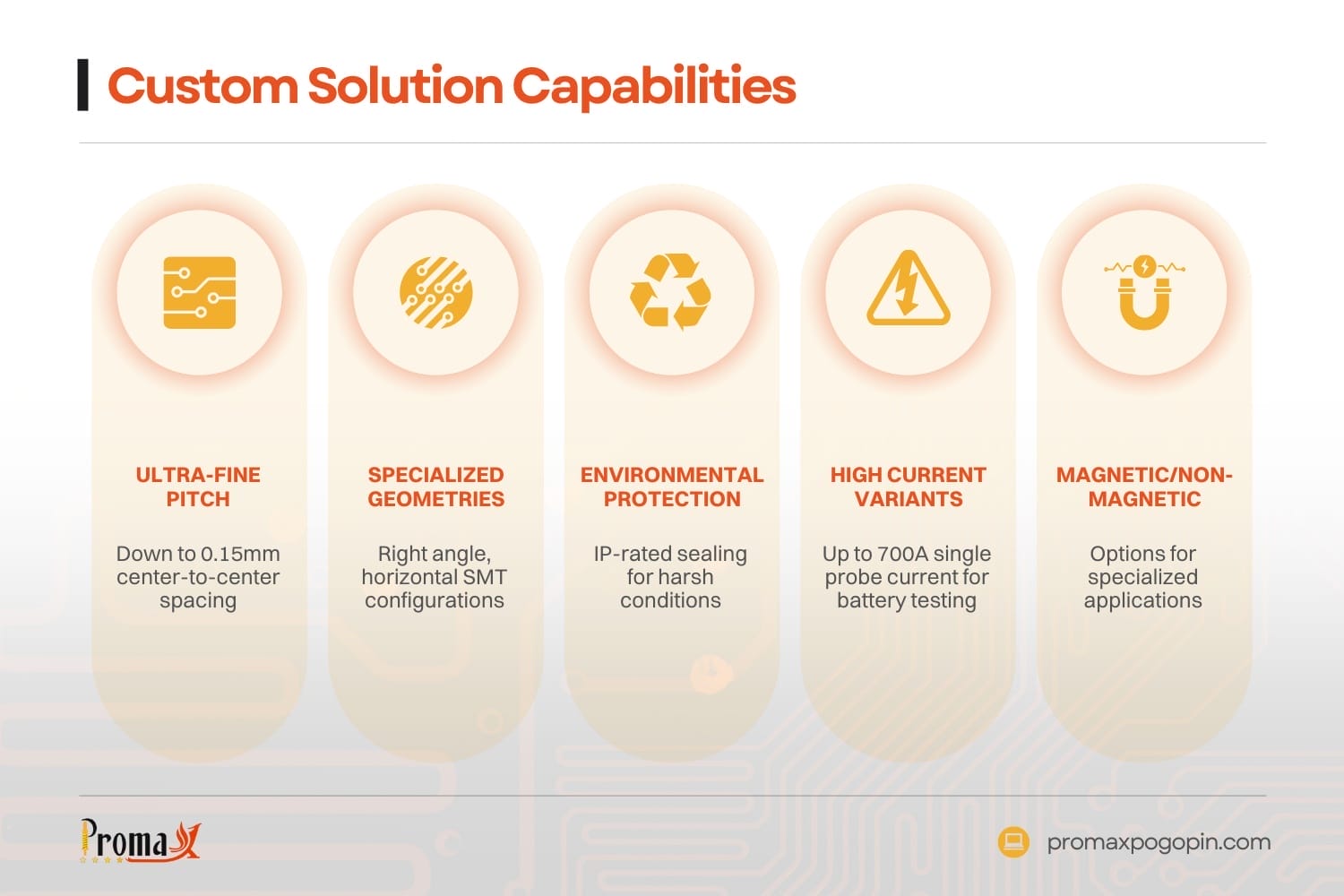
- Ultra-Fine Pitch: Down to 0.15 mm center-to-center spacing
- Specialized Geometries: Right angle, horizontal SMT configurations
- Environmental Protection: IP-rated sealing for harsh conditions
- High Current Variants: Up to 700A single probe current for battery testing
- Magnetic/Non-Magnetic: Options for specialized applications
Design modifications encompass spring force adjustments, plunger geometry optimization, barrel length customization, and specialized plating selections. Custom products support quantities from prototype runs of 100 units to production volumes exceeding 100,000 units annually.
What Quality Standards and Certifications Ensure Reliable Performance?
Promax Pogo Pin fine pitch pogo pins comply with IEC 61010 safety standards for electrical test equipment, ensuring proper insulation and voltage category ratings for intended applications. RoHS compliance guarantees restriction of hazardous substances in manufacturing processes and materials selection. ISO 9001 quality management systems govern all manufacturing operations from material procurement through final inspection.
Testing & Certification Standards
- IEC 61010: Electrical safety for test equipment
- RoHS Compliance: Restriction of hazardous substances
- REACH Directive: Chemical safety compliance
- ISO 9001: Quality management systems
- Accelerated Life Testing: 200,000+ cycle validation
Testing protocols include mechanical durability validation through accelerated life testing exceeding 200,000 mating cycles under specified load conditions. Environmental testing encompasses thermal cycling, humidity exposure, and mechanical shock resistance according to relevant industry standards including aerospace applications.
Ready to Solve Your High-Density Connection Challenges?
Fine pitch pogo pins from Promax Pogo Pin deliver the precision and reliability your application demands. Our unique ball interface technology, ultra-fine 0.15 mm pitch capability, and custom engineering expertise provide a clear advantage over standard solutions.
Contact Promax Pogo Pin today to discuss your fine pitch connectivity needs and discover how our advanced manufacturing capabilities can accelerate your product development while ensuring long-term reliability in the most demanding applications.
Our Partner Said
“Promax Pogo Pin has helped us with many field issues. I have to say their engineers are so experienced and can quickly help me solve the problem. The problem was high temperature caused by excessive current.”
Paul Jelloy
Buyer from the UK

All Other Manufacturing Products
Promax Pogo Pin is a trusted manufacturer specializing in premium connectors and pogo pin solutions. We deliver a wide selection of advanced products to serve varied industry applications, including battery dock connectors, waterproof connectors, medical connectors, BNC connectors, and high-speed connectors. To explore our complete product catalog and discover detailed information on our offerings, please click the links below for more insights.
Fine Pitch Pogo Pins FAQs
What is the minimum pitch achievable with custom fine pitch pogo pins?
Custom fine pitch pogo pins can achieve minimum pitches of 0.15 mm center-to-center spacing through specialized manufacturing processes. This capability requires precise machining tolerances and careful spring design to maintain mechanical reliability while meeting electrical specifications. Applications at this pitch level include advanced semiconductor packages such as chip-scale packages and wafer-level testing where standard connectors cannot provide adequate contact density.
How do fine pitch pogo pins maintain signal integrity in high-frequency applications?
Signal integrity in high-frequency applications is maintained through controlled impedance design and minimized electrical path length within the connector structure. The spring-loaded mechanism provides consistent contact pressure that reduces resistance variations, while gold plating prevents oxidation that could degrade signal quality. Proper grounding techniques and coaxial configurations support bandwidth requirements up to 20 GHz for demanding RF and high-speed digital applications.
What environmental conditions can fine pitch pogo pins withstand?
Fine pitch pogo pins operate reliably across temperature ranges from -45°C to +120°C while maintaining electrical and mechanical specifications. Humidity resistance, vibration tolerance, and chemical compatibility depend on material selection and plating options. Specialized variants with enhanced environmental protection support automotive, aerospace, and industrial applications requiring extended temperature ranges, waterproof sealing, or resistance to specific chemical exposures.